
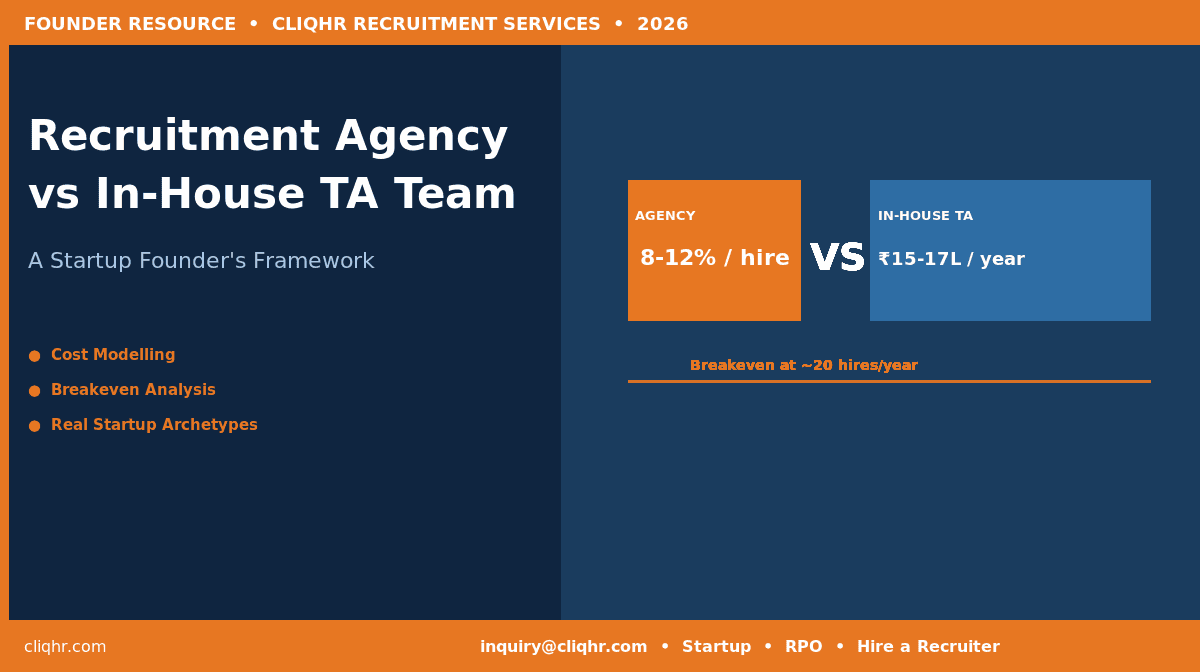
Most startup founders make this decision based on gut feel or the advice of the last recruiter they met. That's expensive. A Series A startup in India that hires 20 engineers at ₹12L CTC through an agency at 10% placement fee spends ₹24 lakhs on recruitment alone — enough to hire a full-time Senior Recruiter plus fund a Naukri RMS subscription for the year. But the same company hiring only 5 engineers pays ₹6 lakhs to the agency — and would have spent ₹17L keeping an in-house recruiter. The math changes everything.
This article gives you the cost model, the breakeven calculation, and a decision matrix built around real startup archetypes — so you can make the call with numbers, not assumptions.
The Real Cost of Each Route
Neither option is inherently cheaper. The right answer depends entirely on your hiring volume, role type, and where you are in the growth curve. Here's how the cost structures compare side by side.
| Cost Element | Agency Route | In-House Route | Notes |
|---|---|---|---|
| Upfront investment | ₹0 | ₹12–18L/yr per recruiter | Salary + benefits + tools |
| Per-hire fee | 8–12% of CTC | ₹0 marginal | Agency fee per placement |
| Time-to-fill | 7–21 days | 30–60 days (ramp-up) | In-house slower initially |
| ATS / sourcing tools | Included | ₹1.5–3L/yr | Naukri, LinkedIn Recruiter, ATS |
| Scalability (surge hiring) | High — pay per hire | Low — limited bandwidth | Agency wins on variable demand |
| Employer branding | None | Builds over time | In-house drives brand equity |
| Breakeven point | Always cost-effective <15 hires/yr | Cost-effective >20–25 hires/yr | See breakeven model below |
Source: CliqHR internal benchmarks; LinkedIn Talent Solutions India pricing guide 2025; Naukri RMS standard plan pricing.
The agency model has zero fixed overhead. You pay only when a hire happens. The in-house model has high fixed cost that only becomes economical at scale.
One number people routinely underestimate: tool costs. A meaningful in-house TA setup needs at minimum a Naukri RMS subscription (₹80K–1.5L/yr), LinkedIn Recruiter Lite (₹1.2L–1.8L/yr), and an ATS. That's ₹2–3L in tooling before a single hire is made.
The Breakeven Model: At What Hiring Volume Does In-House Win?
Assume an average CTC of ₹10 lakhs across your hires — a conservative mid-market IT number in India. Assume agency fee at 10%. In-house recruiter cost: ₹15L CTC + ₹2L tools = ₹17L/yr fixed cost.
| Hires/yr | Agency Cost (10% of ₹10L avg CTC) | In-House Cost (₹15L recruiter + ₹2L tools) | Verdict | Notes |
|---|---|---|---|---|
| 5 | ₹5,00,000 | ₹17,00,000 | Agency cheaper | Breakeven far away |
| 10 | ₹10,00,000 | ₹17,00,000 | Agency cheaper | Still ₹7L savings vs in-house |
| 15 | ₹15,00,000 | ₹17,00,000 | Agency cheaper | Near-breakeven |
| 20 | ₹20,00,000 | ₹17,00,000 | In-house cheaper | Crossover point |
| 30 | ₹30,00,000 | ₹17,00,000 | In-house cheaper | ₹13L annual savings |
| 50 | ₹50,00,000 | ₹24,00,000* | In-house cheaper | *2 recruiters needed |
Assumptions: ₹10L average CTC; 10% agency fee; in-house recruiter at ₹15L CTC; ₹2L annual tool cost. At 50 hires, two recruiters needed.
The crossover happens at roughly 17–20 hires per year. Below that, agency is cheaper every time. Above 20–25 consistent annual hires, in-house begins to create financial advantage — plus the compounding value of institutional knowledge.
Founder Rule of Thumb: If you cannot commit to 20+ hires per year for at least 2 consecutive years, the economics do not justify building an in-house TA function. Use the agency model or an RPO structure instead.
Cost Is Only Half the Decision
Founders who reduce this to a spreadsheet problem miss the strategic dimension. Three factors outside the cost model should drive your thinking.
1. Speed vs Institutionalisation
An agency can deliver shortlisted profiles within 5–7 working days for most IT roles. An in-house recruiter hired today needs 4–6 weeks to onboard, learn your tech stack, and build sourcing channels before delivering reliably. If you just raised a round and need 10 engineers in 60 days, the agency wins regardless of cost.
But at 18 months in, a well-embedded in-house recruiter knows your culture, your engineering team's preferences, and the candidates who declined you last time. That institutional memory has real value that no agency can replicate. Swiggy, Razorpay, and Zepto all built internal TA functions once they reached hiring predictability — not before.
2. Role Complexity
For niche or senior roles — Staff Engineers, ML Researchers, Security Architects — a specialist agency with an active talent network will outperform a generalist in-house recruiter in both reach and speed. The ₹1.5–2L placement fee on a ₹30L CTC hire is negligible compared to a 45-day vacancy in a critical position.
For repeatable mid-level roles — React developers, QA engineers, DevOps engineers — in-house recruiters build sourcing pipelines that reduce time-to-fill from 30 days to 10 days within a quarter. That's where the ROI of in-house becomes undeniable.
3. Employer Brand
Every candidate who interacts with an agency believes they are talking to a third party. They will compare your offer against three other companies the same recruiter is working with. An in-house recruiter controls that narrative entirely. For consumer-facing startups where employer brand is a talent moat — think Cred, Groww, or any fintech competing for the same Bangalore talent pool — in-house TA is eventually non-negotiable.
Real Startup Archetypes: Which Model Fits Each Stage
Here is how the decision maps across actual startup profiles. These reflect common patterns among Indian tech startups across funding stages.
| Archetype | Stage | Hiring Volume | Best Model | Why |
|---|---|---|---|---|
| Bootstrapped SaaS | Pre-Series A | 2–4/yr | Agency | No HR team; speed > cost |
| Funded fintech | Series A | 15–25/yr | Hybrid / RPO | Volume + brand building |
| D2C brand scaling | Series B | 30–50/yr | In-house TA | Predictable volume; culture fit critical |
| Consulting / services startup | Any | Surge-based | Agency on-demand | Variable demand; no fixed overhead |
| Deep-tech / AI startup | Series A–B | 5–10 niche hires | Agency (specialist) | Niche roles; sourcing expertise needed |
The Hybrid / RPO model deserves more attention. Under an RPO arrangement, an external firm like CliqHR provides dedicated recruiters who work as an extension of your team — embedded in your processes, using your ATS, attending your stand-ups — but without the fixed overhead of employment. This is the most underused structure among Series A and B founders.
For companies that have just crossed the 15-hire-per-year threshold but are not yet ready to invest in a full TA team, Recruitment Process Outsourcing gives you the best of both models: institutional continuity without fixed headcount risk.
The Hybrid Approach: Most Founders Get Here Eventually
The cleanest model for a startup between 15–40 hires per year is not a binary choice — it's a tiered structure:
Tier 1 — Agency for niche and senior roles: CTO, Head of Product, Staff Engineers, Security roles. One specialist placement fee is cheaper than 3 months of in-house sourcing for roles where the talent pool is small.
Tier 2 — In-house for repeatable mid-level roles: Your in-house recruiter owns the pipeline for Backend Developers, QA, DevOps. Volume justifies the fixed cost; speed improves with every hire cycle.
Tier 3 — RPO for surge hiring: Series B companies that have a predictable base of hiring but face quarterly surges — product launches, expansion — use RPO as a flexible capacity layer without permanent headcount.
If you need to hire a dedicated in-house recruiter but are not ready to run the hiring process yourself, CliqHR's Hire a Recruiter service lets you source pre-vetted TA professionals who have already worked in tech hiring environments.
Four Situations Where Agency Always Wins
Even if you have an in-house TA team, there are scenarios where bringing in an agency is the correct call:
You are entering a new geography. Expanding to Hyderabad or Pune? An agency with a local candidate network closes roles 40% faster than a central recruiter sourcing cold. CliqHR operates across Chennai, Hyderabad, Pune, Mumbai, Bangalore, and Delhi — see our startup recruitment page for city-specific hiring support.
You need a hire in under 3 weeks. In-house recruiters have bandwidth limits. Agencies can dedicate full attention to a single urgent brief. Most of CliqHR's tech placements complete in 7–14 working days.
The role requires a passive candidate. In-house recruiters primarily work active job boards. Agency recruiters maintain ongoing relationships with candidates who are not applying anywhere — the ₹25L+ engineers who never post on Naukri.
Your last 2–3 in-house placements didn't work out. A pattern of poor hires usually signals a sourcing or screening problem, not a volume problem. Bringing in an agency with structured screening adds a quality filter while you diagnose the root cause.
Decision Matrix: Use This Before You Decide
Run your current situation through this matrix before making the call.
| Situation | Hire Agency | Build In-House | Hybrid / RPO |
|---|---|---|---|
| <10 hires this year | ✓ | ||
| 10–30 hires, 1–2 role types | ✓ | ||
| >30 hires, steady-state hiring | ✓ | ||
| Urgent hire in <2 weeks | ✓ | ||
| Niche / senior role (CTO, Architect) | ✓ | ||
| Building culture + employer brand | ✓ | ||
| Funding just closed, scaling fast | ✓ | ||
| No internal HR bandwidth | ✓ | ||
| Consistent high-volume hiring | ✓ | ||
| Expanding to a new city / market | ✓ |
The Three Mistakes Founders Make
Mistake 1: Hiring an In-House Recruiter Too Early
A TA hire at 8–10 roles per year is almost always a net cost. The recruiter spends 60% of their time on admin, sourcing, and coordination for a volume that an agency handles more efficiently. The result: a full-time salary for part-time output.
Mistake 2: Using Agency Purely for Speed, Then Ignoring the Relationship
Founders who treat agencies as a tap to turn on and off get transactional service. The startups that get the best candidates — the passive ones, the hard-to-find ones — are the ones that maintain a working relationship with two or three agencies year-round, not just when a position opens.
Mistake 3: Building In-House Before You Have an ATS and Job Description Library
An in-house recruiter without a proper ATS and standardised JDs spends weeks rebuilding from scratch every hire cycle. If you cannot provide an organised hiring infrastructure, you will get poor output from even a strong TA hire. Sort your tools before you hire the person.
Frequently Asked Questions
At what company size does it make sense to build an in-house TA team?
Volume matters more than headcount. Most Indian tech startups build in-house TA when they cross 20–25 hires per year on a consistent basis, regardless of whether that is at 50 employees or 200. The exception: high-culture companies like D2C brands where every hire is a brand decision — they often bring TA in-house earlier.
What is a typical agency fee in India for IT hiring?
The standard range is 8–12% of first-year CTC for mid-level roles. Senior or specialist roles (CXO, Staff Engineer, niche tech) attract 12–15%. Some agencies charge a flat retainer for leadership searches. Always negotiate a replacement clause — 60–90 days is standard.
Can I run agency and in-house simultaneously without conflict?
Yes, and it is actually the most common model among Series A and B Indian startups. The key is role segregation: define which role types go to the agency and which go in-house, and hold that boundary. Confusion happens when the same role is worked by both, which creates duplicate effort and candidate confusion.
What is an RPO and when should a startup consider it?
Recruitment Process Outsourcing means a firm manages part or all of your hiring process on your behalf, usually with dedicated recruiters embedded in your team. It suits startups in the 15–40 hires/year range that need institutional hiring capability without permanent headcount. CliqHR's RPO model provides dedicated recruiters, ATS integration, and monthly reporting — learn more about RPO.
How do I evaluate an agency before signing?
Ask three things: (1) How many hires have they made in your specific domain in the last 6 months? (2) What is their average time-to-fill for roles like yours? (3) Can they provide two client references from similar-stage companies? Any agency that cannot answer all three with specifics is not the right partner.
Should I use multiple agencies at the same time?
For volume hiring: yes, running 2–3 agencies simultaneously increases coverage and creates healthy competition. For niche or senior roles: no. Give a specialist agency exclusive access for 2–3 weeks. Shared searches incentivise speed over quality — you get the same 5 profiles from everyone's Naukri database.
Explore: Startup Recruitment | Hire a Recruiter | Recruitment Process Outsourcing | IT Recruitment Services