
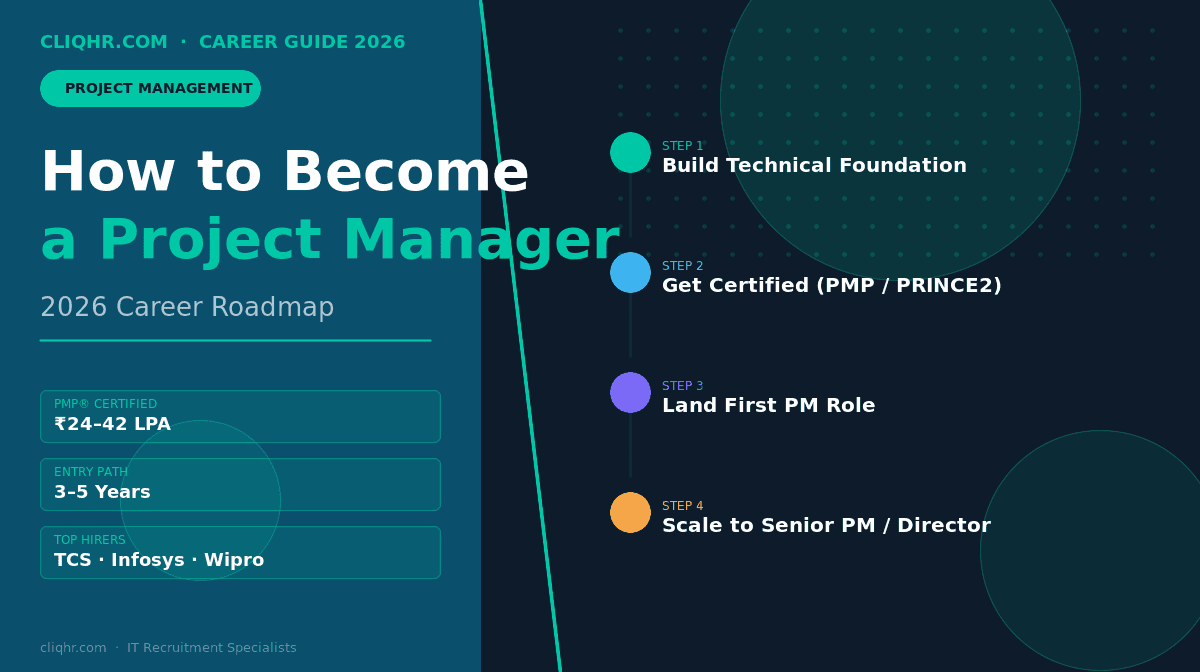
Project management is one of the few roles where a mechanical engineer, a software developer, and an MBA graduate all compete for the same job — and the MBA often loses. In 2026, Indian companies from TCS to Razorpay are promoting technically literate PMs over management generalists. Here's exactly how to break in and move up.
The PM Role in India Has Quietly Split in Two
The title "Project Manager" covers two very different jobs in India's hiring market right now, and choosing the wrong path wastes years.
The first is the IT Project Manager — found at Infosys, Wipro, HCL, and every mid-size IT services firm. This role manages delivery: timelines, client communication, resource allocation, and risk. It pays ₹12–28 LPA at the mid level and almost always requires a PMP® or PRINCE2 certification above the 5-year mark.
The second is the Technical Program Manager (TPM) — found at GCCs like Walmart Global Tech, Citi, and Goldman Sachs technology centres, and at product companies like Swiggy, PhonePe, and Meesho. This role requires engineering depth. Candidates write PRDs, review architecture decisions, and run Agile at scale. Compensation ranges from ₹25–55 LPA at the senior level.
Decide which track fits you before choosing your certification, resume format, or job board. A PRINCE2 certification helps in services; it does nothing for you at a GCC that wants someone who can read a system design diagram.
Step 1: Build the Right Foundation (Years 0–3)
Most PMs arrive from three backgrounds — software engineering, business analysis, or operations. Each brings different strengths and different gaps.
Software Engineers (the most common source in India): You understand technical feasibility and earn instant credibility with developers. Your gap is stakeholder communication and financial tracking. Fix this by owning one cross-functional project at your current company — even a small one involving two teams and a budget.
Business Analysts: You understand requirements and documentation but often lack delivery accountability. Move into a Scrum Master role first. Accenture, Capgemini, and Mphasis regularly hire BAs into Scrum Master positions, which is the fastest bridge into formal PM titles.
Operations professionals: You understand process and risk. Your gap is technology literacy. Take one SQL course (Mode Analytics' free SQL tutorial works), one cloud fundamentals certification (AWS Cloud Practitioner, ₹9,000 exam fee), and list them immediately on LinkedIn. This signals tech readiness without needing a full technical background.
The practical action: Before applying for any PM role, document one project you led end-to-end — even informally. Write it as a mini case study: problem → approach → result → lessons. This becomes the answer to every "tell me about a project you managed" interview question.
Step 2: Get the Certification That Actually Moves the Needle
Three certifications dominate Indian PM job descriptions in 2026. They are not equal, and picking the wrong one for your target role is an expensive mistake.
PMP® (Project Management Professional) is the gold standard for IT services and enterprise roles. TCS, Infosys, Wipro, and Cognizant list it as a preferred qualification on virtually every senior PM job description. The 2026 exam covers predictive (waterfall), agile, and hybrid approaches. Eligibility requires 36 months of project leadership experience and 35 hours of PM education. The exam costs approximately ₹35,000 for PMI members in India. Pass rate hovers around 60% on the first attempt.
PRINCE2 Practitioner is stronger in BFSI — HDFC, Axis Bank, and insurance companies like Bajaj Allianz still list it alongside PMP. If you're targeting banking IT delivery roles, PRINCE2 gives you an edge that PMP doesn't.
PMI-ACP® (Agile Certified Practitioner) is the right add-on if you're targeting product companies or GCCs running Scaled Agile (SAFe). Flipkart, Atlassian India, and Adobe India reference it in TPM job postings. It requires 21 hours of Agile education and 12 months of Agile project experience.
Avoid spending money on generic "Project Management" courses on Udemy or Coursera unless they're explicitly building toward PMP eligibility hours. Hiring managers at large companies cannot verify them, and they add no signal to your resume.
Actionable step: Register for the PMP exam through PMI's website at pmi.org. Applications open immediately. The 35-hour education requirement can be completed in 3–4 weeks through REP providers like Simplilearn or EduPristine (India-based, typically ₹8,000–15,000).
Step 3: Rewrite Your Resume for PM Roles
The single biggest mistake career-changers make is submitting a resume that describes what they did instead of what they delivered. Hiring managers at companies like Mphasis or Persistent Systems read 80–120 PM resumes per week. They skip everything that doesn't show ownership and outcome.
Before (Software Engineer applying for PM):
"Worked on the migration of the legacy billing system to microservices architecture. Collaborated with team members on requirements and testing."
After:
"Led migration of legacy billing system to microservices for a 45-member engineering team. Delivered in 11 months against a 14-month plan, reducing monthly infrastructure cost by ₹18L. Managed 3 vendor dependencies and zero critical escalations."
The formula is: scope + team size + timeline + outcome + risk managed. Every bullet should contain at least three of these five elements.
For tech PM roles at GCCs, add a "Key Projects" section with a 3-line case study format — problem, solution, impact. JPMC Bangalore and Deutsche Bank Technology hire heavily on this format because it mirrors how internal project proposals are written.
If your current resume uses a two-column or table layout, switch to a single-column format immediately. ATS systems used by large IT companies strip formatting from multi-column resumes, and your project scope section ends up in a garbage field. This is covered in detail in our guide on tech resume tips for 2026.
Step 4: Target the Right Companies at the Right Career Stage
Not every company is a good entry point for first-time PMs. Some require prior PM title experience; others actively hire engineers-into-PMs.
Best entry-level PM employers in India (2026): Mid-size IT services firms — Mphasis, Hexaware, KPIT, Birlasoft, and Mastech Digital — are more likely to promote a strong BA or tech lead into a PM role than Tier-1 companies like TCS, which prefers PMP-certified candidates for lateral hires.
GCC entry points: Walmart Global Tech (Bengaluru), Citi Technology (Pune), and ANZ Bengaluru run structured PM hiring programs and clearly define the TPM vs PM distinction in job postings. These are worth targeting after 2–3 years of delivery experience.
Product company entry points: For PM roles at Series B/C startups, the path is different. Companies like Razorpay, Zepto, and Urban Company hire PMs from engineering and product operations — not from IT services backgrounds. If this is your target, build a product portfolio: write public teardowns of apps you use, publish case studies on Medium, and contribute to PM communities like Prodpad India or the PM Exercises Slack group.
The practical step: Go to LinkedIn Jobs, search "Project Manager" filtered to "India" and "Posted in the last 7 days." Save 20 job descriptions. Highlight every required skill mentioned more than 5 times. Those are the gaps to close in the next 6 months.
Looking for IT PM openings right now? Browse current Project Manager job openings at CLIQHR — we actively place PMs across Pune, Hyderabad, Chennai, and Bengaluru.
Step 5: Nail the PM Interview
PM interviews in India's tech sector test three things: your delivery track record, your stakeholder management instincts, and your ability to handle ambiguity. The last one is where most candidates lose.
Delivery track record questions: "Walk me through the most complex project you've managed." Use the STAR format but weight it 30% Situation, 70% Action + Result. Infosys and Wipro interviewers explicitly look for risk identification in the Action section — not just what went right, but what almost went wrong and how you prevented it.
Stakeholder management questions: "How do you handle a client who keeps expanding scope?" The answer they want involves a specific process: change request documentation, impact assessment, and escalation path. Walk through your actual process, not a theoretical one.
Ambiguity questions: "You've been given a project with no budget, no team, and a 3-month deadline. What do you do first?" The right answer starts with clarifying questions, not with a plan. Interviewers at GCCs like Target Tech and Synchrony Financial rate this heavily.
Before any PM interview, read the company's last 2–3 press releases or LinkedIn posts. Know whether they're expanding, cutting, or pivoting. A candidate at Deutsche Bank Technology who references their recent cloud migration initiative signals genuine preparation — and it's a detail that separates offer from rejection.
Step 6: Salary Benchmarks and Negotiation
PM compensation in India varies enormously by company type, city, and certification level. Here are realistic 2026 benchmarks based on CLIQHR's placement data:
IT Services (TCS, Wipro, HCL) — Entry PM (5–7 years exp): ₹12–18 LPA. Mid-senior (8–12 years, PMP certified): ₹18–28 LPA. Program Manager: ₹28–42 LPA.
GCCs (Citi, JP Morgan, Walmart Tech) — PM: ₹22–35 LPA. Senior PM/TPM: ₹35–55 LPA. Director of Program Management: ₹60–90 LPA.
Product Companies (Swiggy, PhonePe, Meesho) — PM: ₹20–35 LPA + ESOPs. Senior PM: ₹35–60 LPA + ESOPs.
The fastest salary jump available to a working PM right now: earn the PMP, then use it to negotiate a lateral move to a GCC. The certification alone adds ₹3–6 LPA at the point of hire in GCC environments, where it's a verified differentiator. For detailed salary negotiation tactics, read our Salary Negotiation guide for 2026.
The AI Factor: What Project Management Looks Like in 2026
AI tools have changed the PM's day — not replaced the role. Understanding where automation helps versus where it creates risk is now a hiring signal.
Tools like Microsoft Copilot in Project, Jira's AI sprint assistant, and ClickUp AI now handle status report generation, risk log updates, and meeting summaries. PMs who delegate these tasks to AI are reclaiming 6–8 hours per week, which shows up in more strategic output and faster project cycles.
What AI cannot do: manage a delayed vendor in Pune who won't escalate to their leadership, navigate a client stakeholder in Singapore who changes requirements on calls but won't write them down, or make the judgment call on whether a critical go-live should be delayed by 2 weeks. These are the irreplaceable parts of the PM role, and companies know it.
The practical implication: If you're preparing for PM interviews in 2026, expect at least one question about which AI tools you use in project delivery and how. Have a specific answer. "I use Copilot to generate weekly status summaries and Jira's AI to triage backlog items before sprint planning" signals fluency. "I haven't really explored AI tools yet" does not.
For a deeper look at how AI is reshaping hiring and careers across India's tech sector, read our article on Upskilling or Obsolescence in India's AI-Driven Job Market.
FAQ
How long does it take to become a Project Manager in India? Most IT professionals make the transition in 3–5 years. The fastest path: start as a BA or Scrum Master (1–2 years), complete your PMP® certification (6–12 months of preparation alongside work), then apply for formal PM roles. Engineers at services firms often get an internal PM title promotion without any certification, but lateral hiring to better-paying companies almost always requires PMP.
Is a PMP certification worth it in 2026? Yes — specifically for IT services and enterprise roles. The certification adds ₹3–6 LPA at the point of lateral hiring in the GCC sector. The total cost including training and exam fees is ₹43,000–55,000. At average salary impact, it pays back within 3 months of the first post-certification salary. (Source: PMI Salary Survey 2023; CLIQHR placement data 2025–26)
Can I become a Project Manager without a technical background? Yes, but the bar is higher. Non-technical PMs succeed most easily in BFSI delivery roles (banking IT projects) and ERP implementations (SAP, Oracle). Companies like Capgemini, Deloitte, and Accenture India hire non-technical PMs for business transformation programs. For product companies and GCCs, a technical foundation is effectively mandatory by the Senior PM level.
Which is better — PMP or MBA for a PM career? For a pure PM track in tech, PMP beats MBA consistently. A PMP is a verified, exam-based credential that hiring managers can check against a PMI registry. An MBA signals management potential but doesn't demonstrate project delivery competence. The exception: if you're targeting consulting firms like McKinsey, BCG, or PwC for program leadership roles, an MBA from an IIM or equivalent opens doors that PMP does not.
What tools should a Project Manager know in 2026? Jira and Confluence (mandatory for Agile/tech roles), MS Project (common in BFSI and manufacturing IT), Smartsheet (used at several GCCs), and at least basic familiarity with Power BI for project reporting. AI-native tools — Microsoft Copilot in Project, ClickUp AI, and Asana's AI features — are now mentioned in 35–40% of senior PM job descriptions. (Source: CLIQHR internal JD analysis, Q1 2026)
How do I get my first PM job with no PM title on my resume? Three tactics that work: (1) Get an internal transfer at your current company — ask your manager to assign you as PM on a small initiative. Any title change to "Project Lead" or "Delivery Manager" counts. (2) Build a portfolio — write case studies on projects you delivered informally. (3) Apply for Scrum Master roles as a bridge. Scrum Masters at Infosys and HCL routinely move to PM titles within 18 months.
Actively looking for Project Manager roles in India? Submit your CV to CLIQHR — we place IT PMs and TPMs across Bengaluru, Hyderabad, Pune, Chennai, and Mumbai. Our recruiters specialise in IT recruitment and work directly with hiring managers at GCCs and IT services firms.