
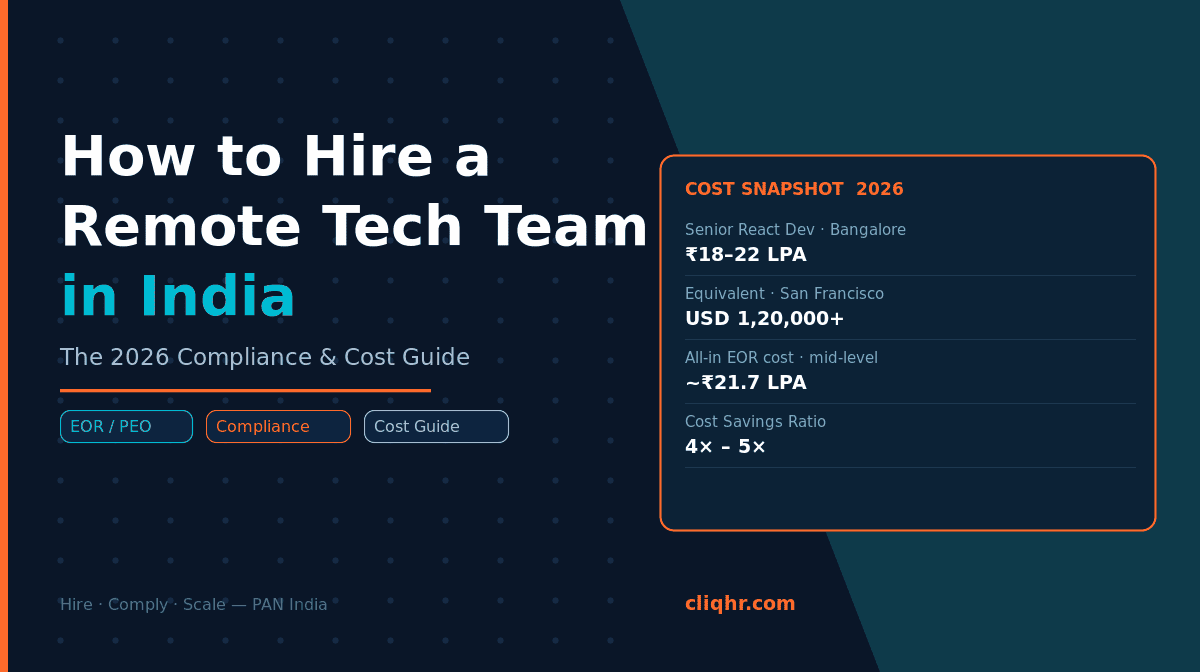
A US-based SaaS startup can hire a senior React developer in Bangalore for ₹18–22 LPA (roughly USD 21,000–26,000 per year) — against USD 120,000–150,000 for the same profile in San Francisco. That cost gap has driven 1,400+ foreign companies to set up India-based tech teams in the last five years, and 2026 is the most active year yet. But the arbitrage only holds if you hire correctly. A bad EOR choice, a misclassified contractor, or a missed PF filing can turn your cost advantage into a compliance nightmare within six months.
This guide covers every decision a founder or hiring manager needs to make — from choosing the right legal structure to understanding what a senior developer in Chennai will actually cost you all-in.
The Three Legal Routes: Direct Hire, EOR, and Contractor — and When Each One Makes Sense
Before you post a single job requirement, you need to decide how the people you hire will be employed. This is not a procedural detail — it determines your tax exposure, your IP ownership, and your ability to scale or exit.
Direct hire via a registered Indian entity means you incorporate a Private Limited company or branch office in India. You become the legal employer. This gives you full control over payroll, benefits, and culture, but incorporation takes 60–120 days, requires a minimum paid-up capital of ₹1 lakh, mandates a local director, and triggers annual compliance filings under the Companies Act 2013. Tata Consultancy Services, Infosys, and Wipro built their global delivery models this way — but they were playing a decades-long game. For a startup hiring its first 5–15 engineers in India, this structure is often premature.
Employer of Record (EOR) is the dominant model for foreign companies in 2026. An EOR like CliqHR becomes the legal employer in India while you retain full day-to-day control of the worker's output. The EOR handles all statutory compliance — Provident Fund (PF), Employee State Insurance (ESI), Professional Tax, TDS, and contract drafting under the Industrial Disputes Act. You pay a monthly fee (typically 8–15% of the employee's CTC), and you are operational within 2–3 weeks. This is the right model for teams of 1–20 people that need to move fast and stay compliant. CliqHR's India PEO and EOR services cover PAN India hiring across all 28 states and 8 union territories.
Independent contractor (freelancer) engagement is the fastest to set up but carries the highest compliance risk. If your "contractor" works exclusively for you, uses your tools, follows your hours, and receives a fixed monthly payment — Indian labour authorities will reclassify them as an employee. The 2021 Code on Social Security has sharpened enforcement of this misclassification risk. Contractor arrangements work best for project-based engagements under 6 months with multiple clients and deliverable-based billing.
Decision rule: Fewer than 5 people, short project duration, varied deliverables → contractor. 5–20 people, ongoing roles, full-time commitment → EOR. 20+ people, multi-year India strategy, product engineering centre → own entity.
What Hiring a Remote Tech Team in India Actually Costs in 2026
The salary is only one part. Foreign companies consistently underprice total employment cost and then experience unpleasant surprises at quarterly tax filing time.
Here is the realistic all-in cost structure for a full-time employee in India:
Gross CTC (Cost to Company) is the headline number candidates negotiate. A mid-level Java developer in Hyderabad commands ₹14–18 LPA in 2026. A DevOps engineer in Pune runs ₹16–22 LPA. A Salesforce developer in Chennai sits at ₹12–20 LPA depending on certifications. (Source: CliqHR IT Salary Benchmarks 2026)
Statutory employer contributions add approximately 13.5–14% on top of basic salary. This breaks down as: Employer PF at 12% of basic (capped at ₹1,800/month), ESI at 3.25% of gross wages (for employees earning up to ₹21,000/month gross), and Gratuity provision at 4.81% for employees completing one year of service. For a developer on ₹18 LPA CTC, statutory contributions add roughly ₹1.5–2.0 LPA to your actual cost.
EOR or PEO management fee if you are not employing directly: typically ₹8,000–25,000 per employee per month depending on the provider and scope of services, including payroll processing, compliance filings, and HR administration.
Equipment, software, and connectivity allowances are standard expectations for remote employees in India. Most companies provide a one-time laptop allowance of ₹50,000–80,000 or reimburse employees for internet expenses at ₹1,000–2,000/month. These are tax-deductible in India.
Total cost model for a mid-level developer at ₹18 LPA CTC:
| Component | Annual (INR) |
|---|---|
| Gross CTC | ₹18,00,000 |
| Employer PF (12% of basic ~₹7L) | ₹84,000 |
| ESI (if applicable) | ₹0–₹29,000 |
| Gratuity provision | ₹86,580 |
| EOR fee (₹15,000/month) | ₹1,80,000 |
| Equipment (amortised) | ₹20,000 |
| Effective Total Cost | ~₹21,70,000 |
At current exchange rates (~₹83.5/USD), a ₹21.7 LPA all-in cost equals approximately USD 26,000 per year — against a US equivalent of USD 110,000–130,000. The 4:1 to 5:1 cost ratio holds even after compliance costs, provided you hire correctly.
The Compliance Checklist: What You Must Get Right Before Day One
India's employment law is state-specific, central-act-layered, and actively enforced. These are the non-negotiable compliance requirements for any foreign company hiring Indian employees remotely in 2026.
Employees' Provident Fund (EPF) registration is mandatory under the Employees' Provident Funds and Miscellaneous Provisions Act 1952 for any establishment employing 20 or more workers. Even if you use an EOR, you should confirm your provider is EPF-registered and that each employee has their Universal Account Number (UAN) activated. Employees contribute 12% of basic salary; employers match it. Failure to remit PF within the due date attracts penal damages of up to 25% of the arrears. (Source: EPFO official guidelines)
Employee State Insurance (ESI) covers employees earning up to ₹21,000/month gross and provides medical, disability, and maternity benefits. Employer contribution is 3.25%; employee contribution is 0.75%. ESI registration is mandatory for establishments with 10 or more employees in most states (20 in some).
Professional Tax is a state-level tax deducted from salaries. Rates vary — Maharashtra charges up to ₹2,500 per year; Karnataka up to ₹2,400; Tamil Nadu ₹2,400. Your payroll system must be state-aware if you have employees across multiple cities.
TDS (Tax Deducted at Source) under Section 192 of the Income Tax Act requires every employer to deduct income tax on salary at the applicable slab rates and remit it to the government on a monthly basis. Annual TDS certificates (Form 16) must be issued to employees by 15th June each year.
Written employment contracts are not merely advisable — they are essential for enforcing IP assignment, non-disclosure, and non-solicitation clauses. The contract must comply with local state Shops and Establishment Acts, which regulate working hours, leave entitlements, and termination notice periods. For remote employees in Karnataka, Tamil Nadu, Telangana, and Maharashtra — the four states where most IT talent concentrates — the Shops and Establishment Act governs these terms.
Data protection compliance has become a material consideration in 2026. The Digital Personal Data Protection Act 2023 (DPDPA) is now in active enforcement. If your Indian remote employees handle personal data of non-Indian residents (which is true for almost every SaaS or tech company), you need a data processing policy, a Data Protection Officer designation for larger teams, and cross-border data transfer safeguards. (Source: Ministry of Electronics and Information Technology, DPDPA 2023)
Where to Hire: City-Wise Talent Pools and What They Cost
Not all Indian tech cities are interchangeable. Where you hire determines salary expectations, bench strength for niche skills, and attrition risk.
Bangalore remains India's highest-salary, highest-talent market. It hosts over 6,000 technology companies and is the first choice for AI/ML, cloud engineering, and product roles. A senior machine learning engineer in Bangalore demands ₹28–45 LPA. Attrition rates in Bangalore run 18–22% annually — the highest in India — because talent has more options here than anywhere else. (Source: TeamLease Employment Outlook Report 2025)
Hyderabad has emerged as the most cost-competitive Tier-1 city in 2026. Microsoft, Google, Apple, and Amazon all operate large engineering campuses here, which has trained a deep bench of cloud and enterprise software professionals. Salaries run 10–15% below Bangalore for comparable profiles. The state government's IT policy offers tax incentives that attract foreign companies establishing their first India entity.
Pune is the preferred hub for product engineering, QA automation, and data engineering. The presence of Persistent Systems, Infosys BPM, and a large Cognizant campus means candidates here are fluent in client-facing delivery models — valuable for foreign companies who need their Indian team to work independently.
Chennai dominates for Salesforce, SAP, mainframe, and infrastructure roles. CTC expectations are 15–20% below Bangalore. The city's talent pool skews toward enterprise software and systems work rather than consumer product development.
Remote-first (non-metro) talent is a 2026 phenomenon worth taking seriously. Post-pandemic, high-quality developers from Coimbatore, Kochi, Jaipur, and Indore are now available at 20–30% below metro rates while working with Bangalore-equivalent tools and practices. For roles that don't require co-location, this is a genuine cost optimisation.
The Hiring Process: From Brief to Onboarded in Under 8 Weeks
Most foreign companies lose 4–6 weeks to process inefficiency before a single interview happens. Here is a realistic, compressed timeline that works in practice.
Week 1–2: Role definition and market positioning. The single most common error is importing a job description written for a US market without adapting it to India. A JD asking for "10+ years of React experience" will disqualify candidates who are technically superior but entered the workforce after React became mainstream. Benchmark the role against Indian market norms: use platforms like Naukri, LinkedIn, and the CLIQHR IT recruitment services team to validate whether the skills and salary you are offering will attract applications. A mismatch here costs 3–4 weeks.
Week 2–4: Sourcing and shortlisting. India's developer talent mostly lives on LinkedIn (for senior/niche roles) and Naukri (for mid-level and volume hiring). Boolean search on LinkedIn Recruiter using location, current company, and specific tech stack delivers a qualified pipeline within 72 hours for mainstream skills. For niche roles — Salesforce CPQ architects, mainframe developers, or data mesh practitioners — a specialist recruiter with an existing network cuts sourcing time by 50% compared to direct search.
Week 4–6: Technical screening and interviews. Build a two-stage interview process: a technical assessment (45–60 minutes, role-specific) followed by a hiring manager conversation. Do not add more than two rounds — candidates with multiple offers in hand (which describes most senior developers in Bangalore and Hyderabad) will drop out of processes with three or more interview stages. If you need structured, objective technical interviews without using your own engineers' time, CLIQHR's Interview-as-a-Service delivers panel interviews conducted by domain experts.
Week 6–8: Offer, compliance setup, and onboarding. Issue the offer letter with the full CTC breakup including all statutory components — Indian candidates scrutinise this closely. If using an EOR, trigger the employment agreement and statutory registration in parallel with the offer acceptance. Collect PAN card, Aadhaar, bank details, and previous employment documents at onboarding. A well-run EOR processes all of this in 5–7 business days.
The Five Mistakes That Undermine Remote India Teams
Companies that struggle with their India teams almost always make the same set of errors. Recognising them in advance is cheaper than fixing them later.
Treating India as a purely execution arm. Teams that receive requirements but no context, no product visibility, and no access to decision-makers consistently underperform. The best Indian developers leave such setups within 12–18 months. Companies like Freshworks and Zoho have demonstrated that India-based product teams can own entire product lines, not just ticket queues.
Not budgeting for attrition. At 18–22% annual attrition in Bangalore and 12–15% in Chennai and Hyderabad, you will lose one in five to one in eight team members every year. Build this into your hiring calendar and your EOR contract (most EOR agreements include replacement clauses — confirm yours does).
Choosing the wrong EOR. Not all EORs are equally compliant. Look for providers who are PF-registered, have an ESI ESIC number, file TDS monthly (not quarterly), carry professional indemnity insurance, and provide an employment contract template that includes IP assignment and DPDPA data processing clauses. Ask for client references from companies in your home country who have used the provider for more than 12 months.
Ignoring the notice period reality. Senior Indian developers commonly have 60–90 day notice periods with their current employers. A hiring timeline that doesn't account for this will result in the candidate withdrawing or accepting a competing offer during the wait. Either negotiate a buyout (companies often cover 30–50% of a candidate's current employer notice period buy-out cost) or adjust your start date expectations at the offer stage.
Underinvesting in onboarding. Remote employees who don't meet a single colleague in their first 30 days have significantly higher dropout rates. Budget for at least one team visit in the first 90 days — either your team visiting India or flying the new hire to your headquarters. The cost (₹1–3 lakh for flights and accommodation) is trivially small relative to a failed hire.
Frequently Asked Questions
Can a foreign company hire employees in India without registering a company there?
Yes. This is precisely what an Employer of Record (EOR) arrangement enables. The EOR registers as the legal employer under Indian law, handles all statutory compliance, and you retain operational control of the employee. It is legal, common, and the standard model for foreign companies building India teams of under 20 people. CliqHR operates as an EOR across all Indian states.
What is the minimum wage for IT professionals in India in 2026?
India's central minimum wage schedule does not directly apply to most IT roles, which are classified as skilled or highly skilled workers. State minimum wages for skilled workers in Karnataka run approximately ₹17,000–20,000 per month in 2026; Tamil Nadu and Maharashtra are in a similar range. In practice, market salaries for IT professionals run 3–8x above statutory minimums. The relevant floor is competitive market rate, not statutory minimum wage.
How long does it take to hire a software developer in India?
For mainstream skills (Java, Python, React, .NET), an active search produces a qualified shortlist within 7–10 working days. Technical screening and interviews take 10–14 days. Notice period adds 30–90 days. Total timeline from job brief to first working day: 8–14 weeks for senior profiles, 6–10 weeks for mid-level.
Is it safe to have Indian employees handle source code and proprietary data?
Yes, provided you have proper IP assignment clauses in employment contracts, NDAs, and data processing policies compliant with India's DPDPA 2023. Require employees to use company-managed devices and cloud environments rather than personal equipment. Most Indian IT professionals are accustomed to these controls — TCS, Infosys, and Wipro have run global delivery operations with these standards for decades.
What happens if I want to exit India — can I terminate an EOR-employed team?
Yes, but there are statutory requirements. Employees employed for more than 240 days in a year are entitled to retrenchment compensation of 15 days' pay per year of service under the Industrial Disputes Act. Notice periods of 30–90 days apply. A professional EOR will manage the exit compliance, calculate the severance correctly, and issue the necessary statutory forms. Budget 45–90 days for a clean exit process.
What is the difference between PEO and EOR in India?
In the Indian context, the terms are often used interchangeably. Strictly, a Professional Employer Organisation (PEO) enters a co-employment arrangement and shares employer responsibilities; an Employer of Record (EOR) is the sole legal employer of record. For practical purposes, both models deliver the same outcome for foreign companies: compliant employment in India without a local entity. CLIQHR offers both structures depending on your operational needs.
Building an India tech team? CLIQHR helps international companies hire, onboard, and manage remote employees across India with full statutory compliance. Learn more about our Hire a Remote Team service or explore our India PEO and EOR services. Ready to discuss your requirements? Contact our team.