
Recruiters build most Naukri shortlists from search results, not from the applications pile, which means your profile can win a shortlist while you sit at your desk doing your day job. Naukri's own blog says recruiters run more than 7 lakh searches a day on its candidate database and that 50-60% of hiring on the platform happens this way (Naukri blog, "The Hidden Demand for Candidates on Naukri"). The catch is that a search is a stack of filters, and one stale field removes you before a human reads a single word.
This guide covers the fields that decide whether you appear, the order to fix them in, and a 10-minute monthly routine that keeps you visible without turning your life into a job hunt.
Recruiters filter first and read second
A recruiter hiring a Spring Boot developer types the skills, sets an experience range and a CTC band, caps the notice period, picks cities, and then narrows to profiles active recently. A recruiter guide from FirstDay AI says a freshness filter such as "updated in the last 15 days" can shrink a 3,500-profile result to roughly 120. Treat that as one vendor's illustration, not a Naukri statistic, but it shows how fast a search shrinks.
Take Arun, a Java developer with six years at Wipro in Chennai who has never applied anywhere on Naukri. His notice period still says 90 days from his last job change, his expected CTC is blank, and his headline reads "Software Engineer". A recruiter searching for 5-8 years, 18-26 LPA and a 30-day notice period never sees him, even though his skills match.
Open your profile now and compare every structured field against the search a recruiter would run for your target role. Anything blank, outdated or unrealistic is a filter you are failing.
How a recruiter's Naukri search narrows from thousands of profiles to a shortlist
Fix the hard-filter fields before you touch anything else
Experience, current CTC, expected CTC, notice period and preferred locations are structured fields, and recruiters filter on them numerically. FirstDay AI's field guide, citing Naukri's recruiter documentation, notes that experience and CTC are mandatory filters for bulk outreach, so a blank or absurd value removes you without any warning.
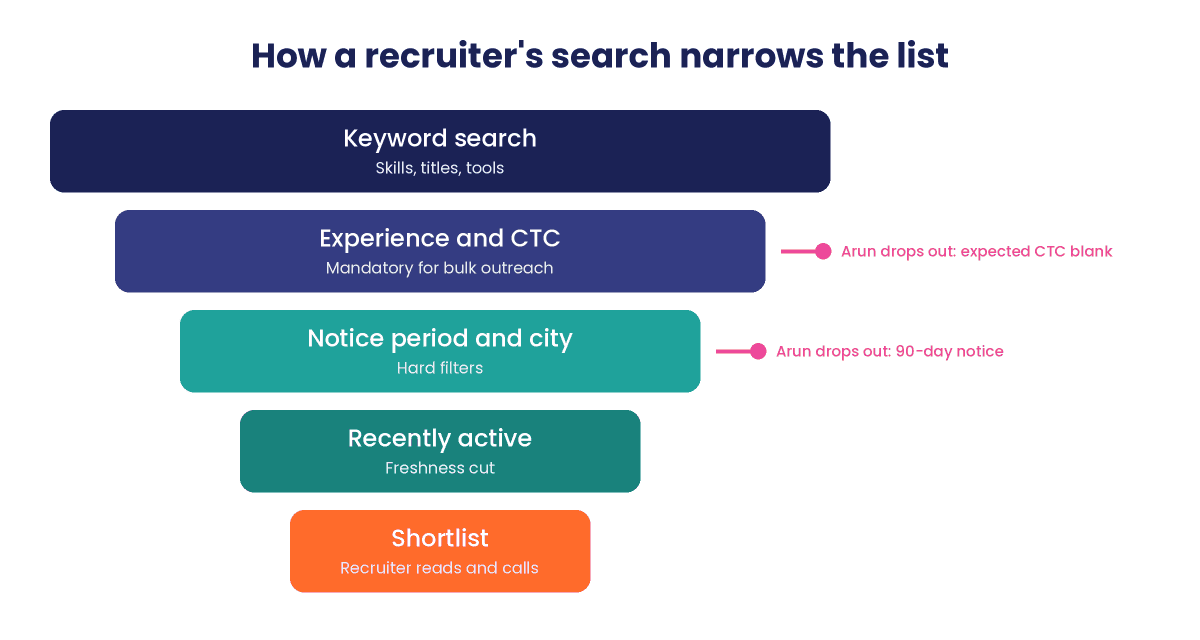
Arun's before: notice period 90 days, expected CTC empty, preferred location Chennai only. Arun's after: notice period set to the 60 days his contract states, with a line in the summary that a buyout is negotiable; expected CTC set as a realistic range; Hyderabad, Bangalore and Pune added because he would move for the right role. Use the 2026 IT salary benchmarks for Chennai, Hyderabad, Pune and Bangalore to anchor your expected range rather than guessing.
Enter your real notice period. Some advice online tells everyone to write "immediate joiner", and the first recruiter call ends badly when it turns out to be false.
Then check your visibility settings and confirm your mobile number and email are verified, because a recruiter cannot shortlist someone they cannot reach. If your employer's recruiters use Resdex, review the privacy options before you go visible.
Rewrite your headline to match the search string
The resume headline is the line under your name, and it shows in every result row before a recruiter opens anything (applycandid.com, "Naukri Applications: What Recruiters Actually See First"). A generic headline loses to one that names the stack and seniority a recruiter is searching for.
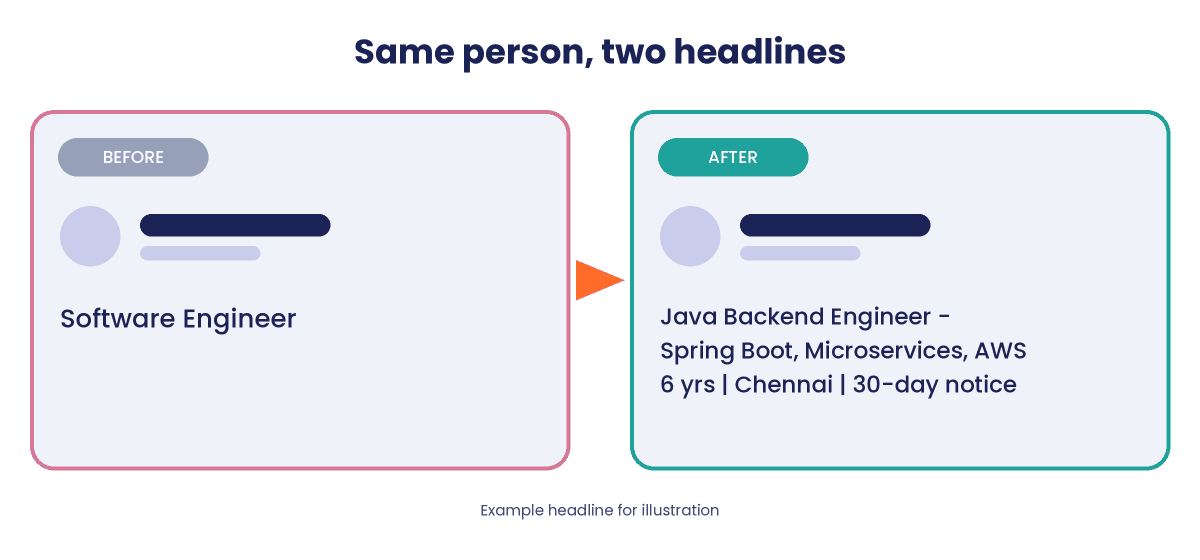
Before and after: a generic Naukri headline versus a keyword-led headline
Before: "Software Engineer". After: "Java Backend Engineer - Spring Boot, Microservices, AWS | 6 yrs | Chennai | 30-day notice". The second version carries the role title, three searchable skills, the experience band and the two filters recruiters care about most.
Copy this template and fill it in with your own details:
[Exact role title] - [Skill 1], [Skill 2], [Skill 3] | [X] yrs | [City] | [Notice period]
Match the role title to what companies print in their postings, such as "Salesforce Developer" rather than "CRM Specialist". Keep the same keywords in your attached resume by following the 9-step ATS-friendly tech resume guide, since the headline gets you found and the resume file gets you shortlisted.
Build Key Skills from three live job descriptions
Key Skills is the field recruiter keyword queries hit hardest. FirstDay AI's field guide ranks it above every other field, followed by the headline and the CTC and notice-period fields. Naukri's recruiter-side blog also cites a presentation stating that 95-98% of searches run on keywords, so exact phrasing matters.
Here is a search a CLIQHR recruiter might run for a backend requirement:
("Spring Boot" OR "Spring MVC") AND Microservices AND (AWS OR Azure) AND Kafka
A profile that lists "Springboot" or "Java frameworks" can miss that string. Pull three current job descriptions for your target role from Naukri or the CLIQHR careers portal, paste them into one document, and count which tools and terms repeat. Add the ones you use in your current job, spelled the way the postings spell them, and put the most-repeated terms first.
Before: "Java, Coding, Problem Solving, Team Player". After: "Java 11, Spring Boot, Microservices, REST APIs, Kafka, AWS, Docker, Jenkins". Soft skills belong in your summary, not in a field that recruiter queries scan for tools.
Mirror the same terms in your LinkedIn profile using the LinkedIn profile checklist for IT professionals in India, because recruiters often search both platforms. The Naukri vs LinkedIn sourcing guide explains how they choose between them.
Write a summary a recruiter can scan in ten seconds
Once a recruiter clicks your row, the profile summary decides whether they download your resume or move to the next name. Most summaries open with adjectives such as "passionate" and "result-oriented", which tell a recruiter nothing they can screen on.
Lead with the facts a recruiter is checking: years, stack, scale and one outcome. Before: "Passionate software professional seeking challenging opportunities in a reputed organisation." After: "Java backend developer with 6 years at Wipro building payment APIs on Spring Boot and AWS. Cut average API response time from 800 ms to 300 ms across 12 services. Open to Chennai, Hyderabad and Bangalore; 60-day notice, buyout negotiable."
Use your own numbers, from your own projects, and keep every figure defensible in an interview. A recruiter who sees a specific outcome in the summary has a reason to call, and a reason to pick you over three profiles with identical skill lists.
Write the summary in three or four short sentences, and put the location and notice period in the last line so the filters and the summary agree with each other.
Keep the profile fresh with real edits, not tricks
Naukri's blog tells job seekers that updating any information on their profile puts them higher in recruiter searches. A whole genre of "hacks" followed, such as adding and deleting a space every morning. Profylo's Resdex guide reports that trivial edits no longer lift the freshness signal the way they once did, so spend your 10 minutes on changes a recruiter would value.
Set a calendar reminder for the first Monday of each month and run one routine. Add the tool or project you used in the last 30 days to your summary. Reorder Key Skills so the most in-demand terms for your target role lead. Re-upload your resume with one updated bullet. Confirm notice period and CTC still match reality.
Do it from your personal phone or laptop, and log in once a week to clear recruiter messages so the account shows regular activity.
Answer recruiters inside a day, even when you're not looking
Naukri's blog advises candidates to reply to recruiter emails, and recruiters notice who answers. A passive candidate who ignores messages for nine days teaches the recruiter to move on, while a short, specific reply keeps the door open on your terms.
Before: no reply, or "Not interested." After: use this template.
Hi [Name], thanks for reaching out. I'm not actively looking, but I'm open to hearing about [role type] if it offers [the one thing you want: product ownership / Hyderabad / a 30-40% hike / remote]. Could you share the company name, team size and CTC range? I'm free for a 15-minute call on [day, time].
This reply screens the opportunity before you spend an hour on it. If you work at TCS, Infosys or Wipro and a message comes from Zoho or Razorpay, the IT services to product company switch guide shows how to judge the move.
If you would rather not manage these conversations yourself, submit your CV to CLIQHR. Our recruiters place candidates with clients such as Globant and Quess, and they can raise suitable roles with you while you keep working.
Read Profile Performance like a dashboard
Naukri's Profile Performance page shows search appearances and recruiter actions over the last 90 days (Naukri FAQ; Coding Ninjas' Naukri guide). Search appearances count how often you appeared in a recruiter's result list, and recruiter actions count views and resume downloads.
Use the two numbers to diagnose the problem. Low appearances point to Key Skills or a hard-filter field. Healthy appearances with few actions point to the headline. FirstDay AI offers a rule of thumb that actions at roughly 2-8% of appearances is healthy; treat that as a vendor heuristic, since Naukri publishes no benchmark.
Example: 1,000 appearances and 15 actions is a 1.5% ratio, so rewrite the headline first. Forty appearances means fix notice period, CTC and skills before anything else.
Screenshot your numbers today, make the changes above, and compare after 30 days. The 90-day window means improvement shows up gradually.
